Birds of Caño Negro Wildlife Refuge
Birdwatching and Photography
Caño Negro Birding List: Complete Bird Species Checklist
Caño Negro Wildlife Refuge is one of Costa Rica’s most important wetland destinations for birdwatching. Its lagoons, waterways, seasonally flooded areas, forest, and open habitats support an extraordinary variety of birdlife, including resident species and migratory birds.
Birdwatchers visiting Caño Negro can encounter hundreds of bird species throughout the year, with the exact species and abundance changing with the seasons and water conditions. The refuge offers opportunities to observe waterbirds, wading birds, raptors, kingfishers, toucans, parrots, and many other species within a relatively compact wetland ecosystem.
This Caño Negro Birding List brings together 477 recorded bird species from the area, providing a practical reference for birders planning a visit to the refuge. The checklist includes the English, Spanish, Dutch, French, and scientific names of each species.
Whether you are an experienced birder preparing a specific species list or a traveller discovering birdwatching in Costa Rica for the first time, this resource can help you understand the remarkable diversity of birds found in Caño Negro.
How to Use the Caño Negro Birding List
This checklist is designed as a practical reference for anyone interested in the birds of Caño Negro Wildlife Refuge. With 477 recorded species, it provides a broader picture of the refuge’s birdlife than a short list of the most commonly seen birds.
The species are presented with their Spanish, English, Dutch, French, and scientific names, making the list useful for birdwatchers from different countries and for anyone who wants to identify a species using its scientific name.
The list represents recorded bird species, not a guarantee of sightings. Bird populations, water levels, weather, migration, and seasonal conditions all influence which species may be encountered during a particular visit. Some birds are regularly observed, while others may be seasonal, uncommon, or difficult to find.
Use the checklist to prepare for your visit, identify species you would like to look for, or create your own personal Caño Negro birding checklist. If you are planning a dedicated birdwatching trip, you can also combine it with our guide to the Birding Experience in Caño Negro and our information about the Caño Negro Wildlife Refuge.
⚠️ Important Note About This Bird List
This checklist is compiled from eBird data for the Caño Negro Wildlife Refuge hotspot and represents 477 species recorded from March 30th, 2008, after many years of observation.
Please keep in mind that:
- Some species on this list may have been recorded only once or a few times, often many years ago.
- A few records may be casual sightings or even misidentifications that have not been fully verified.
- Not all 477 species are regularly seen or guaranteed to be present during a visit.
- Bird populations, seasonal movements, water levels, and weather conditions all influence which species you may actually encounter.
This list is intended as a reference for planning and education, not as a guarantee of sightings. For the best birding experience, we recommend visiting during the dry season (December to April) and hiring a local guide who knows the refuge well.
eBird Field Checklist, Refugio mixto Caño Negro, Alajuela, CR ebird.org/hotspot/L691866
Tinamous (Tinamidae)
Tinamous are ground-dwelling birds associated with forests and dense vegetation. They are generally secretive and are more often heard than seen, making them an interesting group for experienced birdwatchers exploring the habitats around Caño Negro.
| Latin | English | German | French | Dutch |
|---|---|---|---|---|
| Crypturellus soui | Little Tinamou | Zwergtinamu | Tinamou soui | Kleine Tinamoe |
| Tinamus major | Great Tinamou | Großer Tinamu | Grand Tinamou | Grote Tinamoe |
Waterfowl (Anatidae)
Waterfowl are well represented in Caño Negro, with species that range from common residents like the Black-bellied Whistling-Duck to migratory ducks such as the Blue-winged Teal and Northern Pintail. These birds are often seen in the lagoons, canals, and flooded areas of the refuge, especially during the dry season when water levels recede and they concentrate in remaining pools.
| Latin | English | German | French | Dutch |
|---|---|---|---|---|
| Anas acuta | Northern Pintail | Spießente | Canard pilet | Pijlstaart |
| Anas crecca | Green-winged Teal | Krickente | Sarcelle d'hiver | Wintertaling |
| Aythya affinis | Lesser Scaup | Kleine Bergente | Petit Fuligule | Kleine Topper |
| Aythya collaris | Ring-necked Duck | Ringschnabelente | Fuligule à collier | Ringsnaveleend |
| Cairina moschata | Muscovy Duck | Moschusente | Canard musqué | Muskuseend |
| Dendrocygna autumnalis | Black-bellied Whistling-Duck | Herbstpfeifgans | Dendrocygne à ventre noir | Zwartbuikfluiteend |
| Dendrocygna bicolor | Fulvous Whistling-Duck | Gelbbrust-Pfeifgans | Dendrocygne fauve | Rosse Fluiteend |
| Mareca americana | American Wigeon | Amerikanische Pfeifente | Canard d'Amérique | Amerikaanse Smient |
| Nomonyx dominicus | Masked Duck | Maskenente | Érismature routoutou | Maskereend |
| Spatula clypeata | Northern Shoveler | Löffelente | Canard souchet | Slobeend |
| Spatula discors | Blue-winged Teal | Blauflügelente | Sarcelle à ailes bleues | Blauwvleugeltaling |
Herons, Egrets, and Bitterns (Ardeidae)
Herons, egrets, and bitterns are among the most conspicuous birds in Caño Negro. These wading birds are found throughout the wetland, from the open lagoons to the dense marshes. Species like the Great Egret, Green Heron, and Bare-throated Tiger-Heron are commonly seen, while the elusive Agami Heron and Pinnated Bittern are highly sought-after targets for birdwatchers. The refuge provides excellent habitat for both resident and migratory herons throughout the year.
| Latin | English | German | French | Dutch |
|---|---|---|---|---|
| Agamia agami | Agami Heron | Agamireiher | Héron agami | Agamireiger |
| Tigrisoma mexicanum | Bare-throated Tiger-Heron | Nacktkehlreiher | Onoré du Mexique | Mexicaanse Tijgerroerdomp |
| Nycticorax nycticorax | Black-crowned Night Heron | Nachtreiher | Bihoreau gris | Kwak |
| Cochlearius cochlearius | Boat-billed Heron | Kahnschnabel | Savacou huppé | Schuitbekreiger |
| Ardea ibis | Cattle Egret | Kuhreiher | Héron garde-bœufs | Koereiger |
| Ardea alba | Great Egret | Silberreiher | Grande Aigrette | Grote Zilverreiger |
| Ardea herodias | Great Blue Heron | Kanadareiher | Grand Héron | Amerikaanse Blauwe Reiger |
| Butorides virescens | Green Heron | Grünreiher | Héron vert | Groene Reiger |
| Botaurus exilis | Least Bittern | Amerikanische Zwergdommel | Petit Blongios | Amerikaanse Kleine Roerdomp |
| Egretta caerulea | Little Blue Heron | Blaureiher | Aigrette bleue | Kleine Blauwe Reiger |
| Botaurus pinnatus | Pinnated Bittern | Südamerikanische Rohrdommel | Butor brun | Zuid-Amerikaanse Roerdomp |
| Egretta rufescens | Reddish Egret | Rötelreiher | Aigrette rousse | Roodbuikreiger |
| Tigrisoma lineatum | Rufescent Tiger-Heron | Zick-Zack-Reiher | Onoré rayé | Zebra-tijgerroerdomp |
| Egretta thula | Snowy Egret | Schmuckreiher | Aigrette neigeuse | Amerikaanse Kleine Zilverreiger |
| Butorides striata | Striated Heron | Mangrovereiher | Héron strié | Mangrovereiger |
| Egretta tricolor | Tricolored Heron | Dreifarbenreiher | Aigrette tricolore | Witbuikreiger |
| Nyctanassa violacea | Yellow-crowned Night Heron | Krabbenreiher | Bihoreau violacé | Geelkruinkwak |
Chachalacas, Guans, and Curassows (Cracidae)
Chachalacas, guans, and curassows are large, chicken-like birds that inhabit forests and woodland edges. In Caño Negro, the Gray-headed Chachalaca is commonly heard at dawn and dusk, while the Crested Guan and Great Curassow are more secretive and found in forested areas. These birds are important seed dispersers and are often seen moving through the trees in small groups.
| Latin | English | German | French | Dutch |
|---|---|---|---|---|
| Penelope purpurascens | Crested Guan | Purpurhokko | Pénélope panachée | Purperhokko |
| Ortalis cinereiceps | Gray-headed Chachalaca | Graukopftschakalaka | Chachalaca à tête grise | Grijskopchachalaca |
| Crax rubra | Great Curassow | Großer Hokko | Grand Hocco | Grote Hokko |
Pigeons and Doves (Columbidae)
Pigeons and doves are a diverse group in Caño Negro, ranging from the ubiquitous Rock Pigeon to the striking Ruddy Ground Dove and the endemic Nicaraguan Grackle, which is a near-endemic species of the region. These birds are found in a variety of habitats, from open areas to forest edges, and many are common throughout the year.
| Latin | English | German | French | Dutch |
|---|---|---|---|---|
| Patagioenas fasciata | Band-tailed Pigeon | Bandtaube | Pigeon à queue barrée | Bandstaartduif |
| Claravis pretiosa | Blue Ground Dove | Blaue Boden-Täubchen | Colombe bleue | Blauwe Grondduif |
| Columbina passerina | Common Ground Dove | Sperlingstäubchen | Colombe à queue noire | Musduif |
| Leptotila cassinii | Gray-chested Dove | Graubrusttaube | Colombe de Cassin | Grijskapduif |
| Leptotila plumbeiceps | Gray-headed Dove | Graukopftaube | Colombe à tête grise | Grijskopduif |
| Columbina inca | Inca Dove | Inkatäubchen | Colombe inca | Inkatortel |
| Zenaida macroura | Mourning Dove | Carolinataube | Tourterelle triste | Treurtortel |
| Patagioenas cayennensis | Pale-vented Pigeon | Cayennetaube | Pigeon rousset | Rosse Duif |
| Columbina minuta | Plain-breasted Ground Dove | Zwergtäubchen | Colombe naine | Dwergduif |
| Patagioenas flavirostris | Red-billed Pigeon | Rotschnabeltaube | Pigeon à bec rouge | Roodsnavelduif |
| Columba livia | Rock Pigeon | Felsentaube | Pigeon biset | Rotsduif |
| Columbina talpacoti | Ruddy Ground Dove | Rosttäubchen | Colombe rousse | Roodborstduif |
| Geotrygon montana | Ruddy Quail-Dove | Rote Erdtaube | Colombe rouviolette | Rode Kwartelduif |
| Patagioenas speciosa | Scaled Pigeon | Schuppentaube | Pigeon ramier | Schubduif |
| Patagioenas nigrirostris | Short-billed Pigeon | Kurzschnabeltaube | Pigeon à bec noir | Kortsnavelduif |
| Leptotila verreauxi | White-tipped Dove | Blauringtaube | Colombe de Verreaux | Witvlekduif |
| Zenaida asiatica | White-winged Dove | Weißflügeltaube | Tourterelle à ailes blanches | Witvleugeltortel |
Cuckoos (Cuculidae)
Cuckoos are a varied family of birds found in a wide range of habitats, from forests to open woodlands and wetlands. In Caño Negro, species like the Groove-billed Ani and the Squirrel Cuckoo are easily observed, while other cuckoos such as the Yellow-billed Cuckoo are migratory and less frequently encountered. Some members of this family are known for their distinctive calls and secretive habits.
| Latin | English | German | French | Dutch |
|---|---|---|---|---|
| Piaya cayana | Common Squirrel-Cuckoo | Eichhörnchenkuckuck | Piaye écureuil | Eekhoornkoekoek |
| Crotophaga major | Greater Ani | Großer Ani | Ani des palétuviers | Grote Ani |
| Crotophaga sulcirostris | Groove-billed Ani | Riefenschnabelani | Ani à bec cannelé | Groefsnavelani |
| Morococcyx erythropygus | Lesser Ground-Cuckoo | Kleiner Grundkuckuck | Géocoucou de Lesson | Kleine Grondkoekoek |
| Coccyzus minor | Mangrove Cuckoo | Mangrovenkuckuck | Coulicou manioc | Mangrove-koekoek |
| Tapera naevia | Striped Cuckoo | Gestreifter Kuckuck | Géocoucou tacheté | Gestreepte Koekoek |
| Coccyzus americanus | Yellow-billed Cuckoo | Gelbschnabelkuckuck | Coulicou à bec jaune | Geelsnavelkoekoek |
Nightjars (Caprimulgidae)
Nightjars are crepuscular and nocturnal birds known for their cryptic plumage and distinctive calls. In Caño Negro, species like the Common Pauraque are frequently heard at dusk and dawn, while others such as the Lesser Nighthawk can be seen flying over open areas. These birds are most active during twilight hours when they hunt for insects in flight.
| Latin | English | German | French | Dutch |
|---|---|---|---|---|
| Antrostomus carolinensis | Chuck-will's-widow | Carolinachuck-will's-widow | Engoulevent de Caroline | Carolinachuck-will's-widow |
| Chordeiles minor | Common Nighthawk | Falkennachtschwalbe | Engoulevent d'Amérique | Amerikaanse Nachtzwaluw |
| Nyctidromus albicollis | Common Pauraque | Blassbauch-Nachtschwalbe | Engoulevent pauraqué | Pauraque |
| Chordeiles acutipennis | Lesser Nighthawk | Texasnachtschwalbe | Engoulevent à ailes luisantes | Texasnachtzwaluw |
| Lurocalis semitorquatus | Short-tailed Nighthawk | Kurzschwanz-Nachtschwalbe | Engoulevent à queue courte | Kortstaartnachtzwaluw |
Potoos (Nyctibiidae)
Potoos are nocturnal birds related to nightjars, but with a more upright posture and a distinctive, camouflaged appearance that allows them to blend seamlessly with tree branches. In Caño Negro, the Common Potoo is frequently heard after dark, while the larger Great Potoo is also present. These birds are masters of camouflage and are more often detected by their haunting calls than by sight.
| Latin | English | German | French | Dutch |
|---|---|---|---|---|
| Nyctibius griseus | Common Potoo | Urutau | Ibijau commun | Gewone Potoo |
| Nyctibius grandis | Great Potoo | Großer Tagschläfer | Grand Ibijau | Grote Potoo |
| Nyctibius jamaicensis | Northern Potoo | Jamaika-Tagschläfer | Ibijau de Jamaïque | Jamaicapotoo |
Swifts (Apodidae)
Swifts are aerial specialists that spend most of their lives in flight. In Caño Negro, several species can be seen soaring over the wetland and forest, often in mixed flocks. They are most active during the morning and late afternoon, feeding on insects caught in flight.
| Latin | English | German | French | Dutch |
|---|---|---|---|---|
| Streptoprocne rutila | Chestnut-collared Swift | Rotkopfsegler | Martinet à collier roux | Roodkraaggierzwaluw |
| Chaetura pelagica | Chimney Swift | Schornsteinsegler | Martinet ramoneur | Schoorsteengierzwaluw |
| Chaetura cinereiventris | Gray-rumped Swift | Graubürzelsegler | Martinet à croupion gris | Grijsstuitgierzwaluw |
| Panyptila cayennensis | Lesser Swallow-tailed Swift | Kleine Schwalbensegler | Martinet de Cayenne | Kleine Zwaluwstaartgierzwaluw |
| Cypseloides cherriei | Spot-fronted Swift | Stirnflecksegler | Martinet de Cherrie | Vlekvoorhoofdgierzwaluw |
| Chaetura vauxi | Vaux's Swift | Vauxsegler | Martinet de Vaux | Vaux' Gierzwaluw |
| Cypseloides cryptus | White-chinned Swift | Weißkinnsegler | Martinet à menton blanc | Witkingierzwaluw |
| Streptoprocne zonaris | White-collared Swift | Halsbandsegler | Martinet à collier blanc | Witkraaggierzwaluw |
Hummingbirds (Trochilidae)
Hummingbirds are among the most colorful and fascinating birds in Caño Negro. These tiny, energetic birds are often seen visiting flowers in the forest edges and gardens. With their iridescent plumage and remarkable flying abilities, they are a favorite among birdwatchers and photographers alike.
| Latin | English | German | French | Dutch |
|---|---|---|---|---|
| Threnetes ruckeri | Band-tailed Barbthroat | Bandschwanz-Schattenkolibri | Ermite de Rucker | Bandstaartheremietkolibrie |
| Lophornis helenae | Black-crested Coquette | Schwarzhaubenelfe | Coquette à crête noire | Zwartkuifkoketkolibrie |
| Polyerata amabilis | Blue-chested Hummingbird | Blausternamazilie | Ariane à poitrine bleue | Blauwborstamazilia |
| Chlorestes eliciae | Blue-throated Goldentail | Blaukehl-Glanzschwanz | Colibri d'Élicia | Blauwkeelgoudstaart |
| Saucerottia hoffmanni | Blue-vented Hummingbird | Hoffmanns Amazilie | Ariane de Hoffmann | Hoffmanns Amazilia |
| Glaucis aeneus | Bronzy Hermit | Bronzekolibri | Ermite d'Aeneus | Bronsheremietkolibrie |
| Chalybura urochrysia | Bronze-tailed Plumeleteer | Bronzeschwanzkolibri | Colibri à queue bronzée | Bronsstaartpluimdrager |
| Amazilia rutila | Cinnamon Hummingbird | Zimtamazilie | Ariane cannelle | Kaneelamazilia |
| Thalurania colombica | Crowned Woodnymph | Kronenfee | Dryade à couronne violette | Gekroonde Bosnimf |
| Anthracothorax prevostii | Green-breasted Mango | Grünbrust-Mangokolibri | Mango à poitrine verte | Groenborstmango |
| Heliomaster longirostris | Long-billed Starthroat | Langschnabel-Sternkolibri | Colibri à long bec | Langsnavelsterkeel |
| Phaethornis longirostris | Long-billed Hermit | Langschnabel-Schattenkolibri | Ermite à long bec | Langsnavelheremietkolibrie |
| Heliomaster constantii | Plain-capped Starthroat | Graukappen-Sternkolibri | Colibri à calotte grise | Grijskopsterkeel |
| Heliothryx barroti | Purple-crowned Fairy | Purpurhäubchenelfe | Colibri de Barrot | Purperkapfee |
| Archilochus colubris | Ruby-throated Hummingbird | Rubinkehlkolibri | Colibri à gorge rubis | Robijnkeelkolibrie |
| Amazilia tzacatl | Rufous-tailed Hummingbird | Rotbauchamazilie | Ariane à ventre roux | Roodstaartamazilia |
| Phaeochroa cuvierii | Scaly-breasted Hummingbird | Schuppenbrustkolibri | Colibri de Cuvier | Schubborstkolibrie |
| Phaethornis striigularis | Stripe-throated Hermit | Streifenkehl-Schattenkolibri | Ermite à gorge striée | Streepkeelheremietkolibrie |
| Klais guimeti | Violet-headed Hummingbird | Veilchenkopfkolibri | Colibri à tête violette | Violetkopkolibrie |
| Chlorestes candida | White-bellied Emerald | Weißbauch-Smaragdkolibri | Émeraude candide | Witbuiksmaragdkolibrie |
| Florisuga mellivora | White-necked Jacobin | Weißnackenkolibri | Colibri jacobin | Witnekjacobijn |
Rails, Gallinules, and Allies (Rallidae)
Rails, gallinules, and coots are a diverse group of wetland birds found throughout Caño Negro. Many are secretive and prefer dense marsh vegetation, while others like the Common Gallinule and Purple Gallinule are more visible and often seen foraging in open water. The Sungrebe, though not a true rail, is also included here due to its similar habitat preferences.
| Latin | English | German | French | Dutch |
|---|---|---|---|---|
| Fulica americana | American Coot | Amerikanisches Blässhuhn | Foulque d'Amérique | Amerikaanse Meerkoet |
| Gallinula galeata | Common Gallinule | Zwergteichhuhn | Gallinule d'Amérique | Amerikaans Waterhoen |
| Laterallus exilis | Gray-breasted Crake | Graubrust-Sumpfhuhn | Râle à poitrine grise | Grijsborstral |
| Porphyrio martinica | Purple Gallinule | Zwergsultanshuhn | Talève violacée | Amerikaans Purperhoen |
| Aramides albiventris | Russet-naped Wood-Rail | Rotnacken-Waldralle | Râle à nuque rousse | Roodnekbosral |
| Porzana carolina | Sora | Carolinasumpfhuhn | Marouette de Caroline | Sora |
| Pardirallus maculatus | Spotted Rail | Tüpfelralle | Râle tacheté | Gevlekte Ral |
| Amaurolimnas concolor | Uniform Crake | Einfarbralle | Râle concolore | Effen Ral |
| Laterallus albigularis | White-throated Crake | Weißkehl-Sumpfhuhn | Râle à gorge blanche | Witkeelral |
| Laterallus flaviventer | Yellow-breasted Crake | Gelbbrust-Sumpfhuhn | Râle à poitrine jaune | Geelborstral |
Finfoots (Heliornithidae)
The Sungrebe is the only member of the finfoot family found in the Americas. In Caño Negro, this unique and secretive bird is most often seen swimming in still waters and along the edges of lagoons and canals. It is more often heard than seen and is a special find for any birder visiting the refuge.
| Latin | English | German | French | Dutch |
|---|---|---|---|---|
| Heliornis fulica | Sungrebe | Binsenralle | Grébifoulque d'Amérique | Kleine Fuutkoet |
Limpkin (Aramidae)
The Limpkin is a distinctive wading bird that feeds almost exclusively on apple snails, making it a common sight in Caño Negro's wetlands. Its long, curved bill and loud, piercing calls make it easily recognizable. These birds are often seen foraging along the edges of lagoons and canals throughout the refuge.
| Latin | English | German | French | Dutch |
|---|---|---|---|---|
| Aramus guarauna | Limpkin | Rallenkranich | Aramus | Koerlan |
Thick-knees (Burhinidae)
The Double-striped Thick-knee is the only species of this family found in Caño Negro. These nocturnal shorebirds are more often heard than seen, with their distinctive calls echoing across open areas at dusk and during the night. They prefer dry, open habitats near the wetland and are occasionally observed during the day when resting.
| Latin | English | German | French | Dutch |
|---|---|---|---|---|
| Hesperoburhinus bistriatus | Double-striped Thick-knee | Doppelbinden-Triele | Oedicnème bistrié | Dubbelebandgriel |
Stilts and Avocets (Recurvirostridae)
The Black-necked Stilt is the only representative of this family regularly found in Caño Negro. These elegant waders are easily recognized by their extremely long pink legs and striking black-and-white plumage. They are commonly seen foraging in shallow water, often in small groups, and can be observed throughout the year.
| Latin | English | German | French | Dutch |
|---|---|---|---|---|
| Himantopus mexicanus | Black-necked Stilt | Schwarznacken-Stelzenläufer | Échasse d'Amérique | Amerikaanse Steltkluut |
Plovers and Lapwings (Charadriidae)
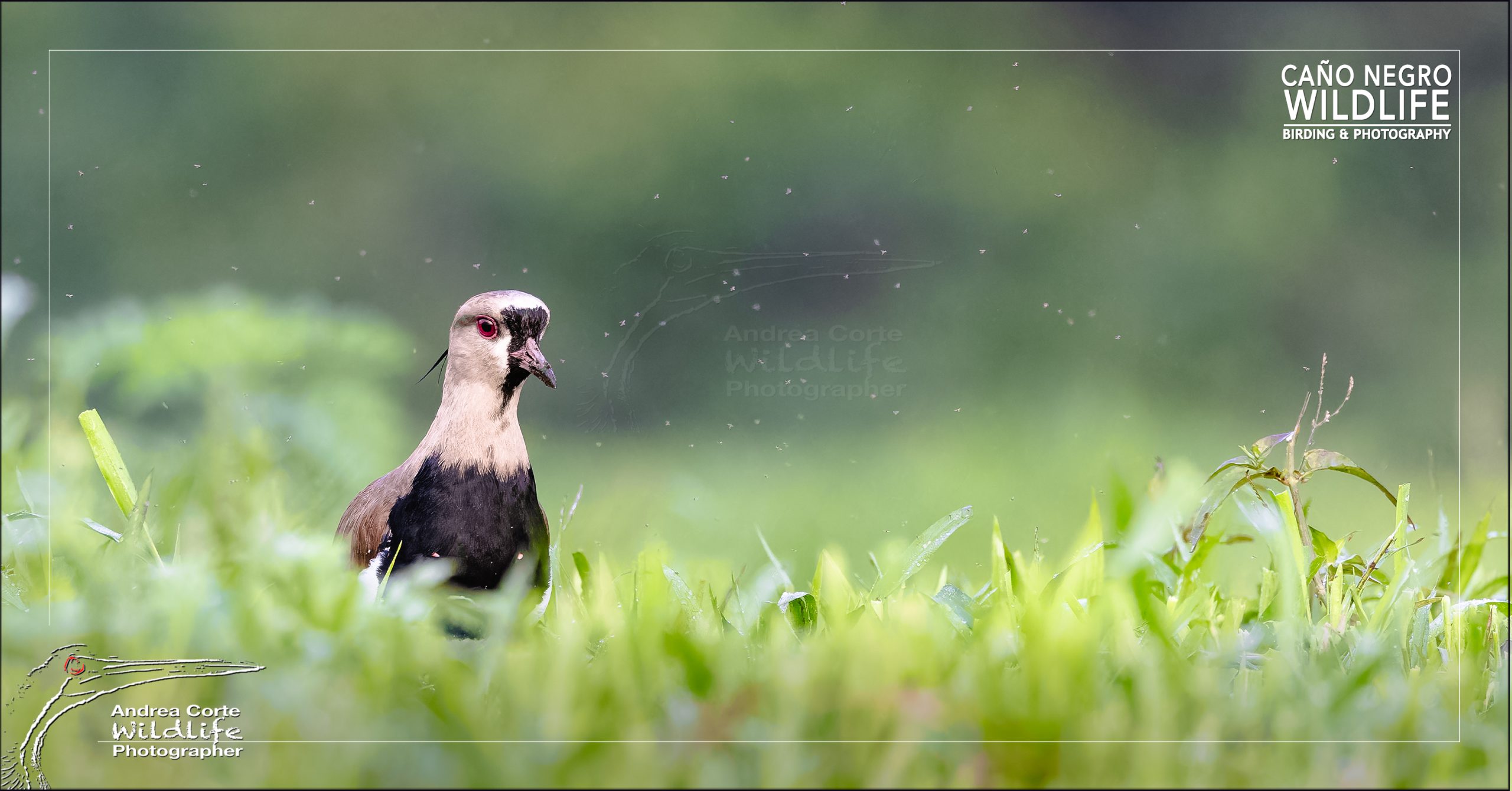
Plovers and lapwings are shorebirds found in open areas, mudflats, and along the shores of lagoons and rivers. In Caño Negro, the Southern Lapwing is a common and conspicuous resident, while several migratory plovers visit during the winter months. The Killdeer, with its distinctive kill-dee call, is also frequently encountered in open habitats near water.
| Latin | English | German | French | Dutch |
|---|---|---|---|---|
| Pluvialis dominica | American Golden-Plover | Amerikanischer Goldregenpfeifer | Pluvier dominicain | Amerikaanse Goudplevier |
| Pluvialis squatarola | Black-bellied Plover | Kiebitzregenpfeifer | Pluvier argenté | Zilverplevier |
| Anarhynchus collaris | Collared Plover | Collarplover | Pluvier à collier | Halsbandplevier |
| Charadrius vociferus | Killdeer | Keilschwanz-Regenpfeifer | Pluvier kildir | Killdeerplevier |
| Charadrius semipalmatus | Semipalmated Plover | Halbringregenpfeifer | Pluvier semipalmé | Amerikaanse Bontbekplevier |
| Vanellus chilensis | Southern Lapwing | Bronzekiebitz | Vanneau téro | Chileense Kievit |
| Anarhynchus wilsonia | Wilson's Plover | Wilson-Regenpfeifer | Pluvier de Wilson | Wilsons Plevier |
Jacanas (Jacanidae)
The Northern Jacana is the only member of this family found in Caño Negro. These distinctive birds are easily recognized by their long toes, which allow them to walk on floating vegetation, and their striking chestnut-and-black plumage. They are commonly seen in marshes and lagoons, often calling loudly and displaying territorial behavior.
| Latin | English | German | French | Dutch |
|---|---|---|---|---|
| Jacana spinosa | Northern Jacana | Gelbstirn-Blatthühnchen | Jacana du Nord | Noordelijke Jacana |
Sandpipers, Snipes, and Allies (Scolopacidae)
Sandpipers, snipes, and their allies are a diverse group of shorebirds that inhabit mudflats, shallow water, and marshy areas. In Caño Negro, this family includes both resident species and migratory visitors from North America, making them an important component of the wetland bird community.
| Latin | English | German | French | Dutch |
|---|---|---|---|---|
| Calidris bairdii | Baird's Sandpiper | Bairdstrandläufer | Bécasseau de Baird | Bairds Strandloper |
| Tringa melanoleuca | Greater Yellowlegs | Großer Gelbschenkel | Grand Chevalier à pattes jaunes | Grote Geelpootruiter |
| Numenius hudsonicus | Hudsonian Whimbrel | Hudsonschnepfe | Courlis hudsonien | Amerikaanse Regenwulp |
| Calidris minutilla | Least Sandpiper | Wiesenstrandläufer | Bécasseau minuscule | Kleine Strandloper |
| Tringa flavipes | Lesser Yellowlegs | Kleiner Gelbschenkel | Petit Chevalier à pattes jaunes | Kleine Geelpootruiter |
| Limnodromus scolopaceus | Long-billed Dowitcher | Große Schlammschnepfe | Bécassin à long bec | Grote Slakruiter |
| Calidris melanotos | Pectoral Sandpiper | Grasläufer | Bécasseau à poitrine cendrée | Gestreepte Strandloper |
| Arenaria interpres | Ruddy Turnstone | Steinwälzer | Tournepierre à collier | Steenloper |
| Calidris alba | Sanderling | Sanderling | Bécasseau sanderling | Drieteenstrandloper |
| Calidris pusilla | Semipalmated Sandpiper | Sandstrandläufer | Bécasseau semipalmé | Grijze Strandloper |
| Limnodromus griseus | Short-billed Dowitcher | Kleine Schlammschnepfe | Bécassin à bec court | Kleine Slakruiter |
| Tringa solitaria | Solitary Sandpiper | Einsamer Wasserläufer | Chevalier solitaire | Amerikaanse Bosruiter |
| Actitis macularius | Spotted Sandpiper | Fleckenwasserläufer | Chevalier grivelé | Amerikaanse Oeverloper |
| Calidris himantopus | Stilt Sandpiper | Bindenstrandläufer | Bécasseau à échasses | Steltstrandloper |
| Calidris mauri | Western Sandpiper | Bergstrandläufer | Bécasseau d'Alaska | Westelijke Strandloper |
| Calidris fuscicollis | White-rumped Sandpiper | Weißbürzel-Strandläufer | Bécasseau à croupion blanc | Witrugstrandloper |
| Tringa semipalmata | Willet | Schlammtreter | Chevalier semipalmé | Willet |
| Gallinago delicata | Wilson's Snipe | Wilsonbekassine | Bécassine de Wilson | Wilsons Snip |
| Phalaropus tricolor | Wilson's Phalarope | Wilsonwassertreter | Phalarope de Wilson | Wilsons Franjepoot |
Gulls, Terns, and Skimmers (Laridae)
Gulls, terns, and skimmers are a diverse family of waterbirds commonly found along coastlines, rivers, and wetlands. In Caño Negro, several species of terns are regularly observed, with the Black Skimmer being one of the most distinctive and sought-after birds in the area.
| Latin | English | German | French | Dutch |
|---|---|---|---|---|
| Chlidonias niger | Black Tern | Trauerseeschwalbe | Guifette noire | Zwarte Stern |
| Rynchops niger | Black Skimmer | Amerikanischer Scherenschnabel | Bec-en-ciseaux noir | Amerikaanse Schaarbek |
| Hydroprogne caspia | Caspian Tern | Raubseeschwalbe | Sterne caspienne | Reuzenstern |
| Sterna hirundo | Common Tern | Flussseeschwalbe | Sterne pierregarin | Visdief |
| Gelochelidon nilotica | Gull-billed Tern | Lachseeschwalbe | Sterne hansel | Lachstern |
| Leucophaeus atricilla | Laughing Gull | Lachmöwe | Mouette atricille | Lachmeeuw |
| Thalasseus maximus | Royal Tern | Königsseeschwalbe | Sterne royale | Koningsstern |
| Thalasseus sandvicensis | Sandwich Tern | Brandseeschwalbe | Sterne caugek | Grote Stern |
| Sternula superciliaris | Yellow-billed Tern | Amazonasseeschwalbe | Sterne à bec jaune | Geelsnavelstern |
Grebes (Podicipedidae)
Grebes are small to medium-sized diving birds found in freshwater lakes and lagoons. In Caño Negro, the Pied-billed Grebe is the most commonly observed species, often seen diving for fish and aquatic invertebrates. The Least Grebe is also occasionally present. These birds are excellent swimmers and are often heard before they are seen.
| Latin | English | German | French | Dutch |
|---|---|---|---|---|
| Tachybaptus dominicus | Least Grebe | Kleinsttaucher | Grèbe minime | Amerikaanse Dodaars |
| Podilymbus podiceps | Pied-billed Grebe | Bindentaucher | Grèbe à bec bigarré | Dikbekfuut |
Sunbittern (Eurypygidae)
The Sunbittern is a unique and beautiful bird found along forested streams and rivers in Caño Negro. Despite its name, it is not closely related to bitterns but belongs to its own family. It is easily recognized by its intricate wing pattern and its habit of slowly walking along the water's edge. This species is a special sighting for birders exploring the refuge's waterways.
| Latin | English | German | French | Dutch |
|---|---|---|---|---|
| Eurypyga helias | Sunbittern | Sonnenralle | Caurale soleil | Zonneral |
Storks (Ciconiidae)
Storks are large, long-legged wading birds with a distinctive appearance. In Caño Negro, the Jabiru is a flagship species of the wetland and one of the largest flying birds in the Americas. The Wood Stork is also present and often seen foraging in shallow waters. Both species are important indicators of healthy wetland ecosystems.
| Latin | English | German | French | Dutch |
|---|---|---|---|---|
| Jabiru mycteria | Jabiru | Jabiru | Jabiru d'Amérique | Jabiroe |
| Mycteria americana | Wood Stork | Waldstorch | Tantale d'Amérique | Kaalkopooievaar |
Frigatebirds (Fregatidae)
Frigatebirds are large seabirds known for their aerial prowess and distinctive silhouettes. In Caño Negro, the Magnificent Frigatebird is occasionally seen soaring over the wetland, often in search of food or riding thermals. These birds are more commonly found along the coast, but they can wander inland, making them a noteworthy sighting in the refuge.
| Latin | English | German | French | Dutch |
|---|---|---|---|---|
| Fregata magnificens | Magnificent Frigatebird | Prachtfregattvogel | Frégate superbe | Amerikaanse Fregatvogel |
Cormorants (Phalacrocoracidae)
Cormorants are medium to large waterbirds that dive for fish and other aquatic prey. In Caño Negro, the Neotropic Cormorant is the only member of this family regularly recorded. It is often seen swimming low in the water, diving, or perched with its wings spread open to dry after fishing.
| Latin | English | German | French | Dutch |
|---|---|---|---|---|
| Nannopterum brasilianum | Neotropic Cormorant | Olivenscharbe | Cormoran vigua | Bigua-aalscholver |
Ibises and Spoonbills (Threskiornithidae)
Ibises and spoonbills are wading birds with long, curved bills adapted for foraging in shallow water and mud. In Caño Negro, the Green Ibis and White Ibis are common residents, while the Roseate Spoonbill is one of the most colourful and sought-after birds in the refuge. The Glossy Ibis is also present, particularly during migration. These birds are often seen foraging in mixed flocks in the wetland.
| Latin | English | German | French | Dutch |
|---|---|---|---|---|
| Plegadis falcinellus | Glossy Ibis | Braunsichler | Ibis falcinelle | Zwarte Ibis |
| Mesembrinibis cayennensis | Green Ibis | Grünibis | Ibis vert | Groene Ibis |
| Platalea ajaja | Roseate Spoonbill | Rosalöffler | Spatule rosée | Rode Lepelaar |
| Eudocimus albus | White Ibis | Schneesichler | Ibis blanc | Witte Ibis |
Pelicans (Pelecanidae)
Pelicans are large waterbirds known for their distinctive throat pouches and impressive wingspans. In Caño Negro, the Brown Pelican is occasionally recorded, typically as a vagrant wandering inland from coastal areas. Although not a regular resident, its presence is always noteworthy for birdwatchers visiting the refuge.
| Latin | English | German | French | Dutch |
|---|---|---|---|---|
| Pelecanus erythrorhynchos | American White Pelican | Nashornpelikan | Pélican d'Amérique | Witte Pelikaan |
| Pelecanus occidentalis | Brown Pelican | Braunpelikan | Pélican brun | Bruine Pelikaan |
New World Vultures (Cathartidae)
New World vultures are scavengers that play an important ecological role in the wetland ecosystem. In Caño Negro, the Black Vulture and Turkey Vulture are common and easily observed soaring overhead, while the King Vulture is a more uncommon sighting. The Lesser Yellow-headed Vulture is also present, often associated with water and wetland areas.
| Latin | English | German | French | Dutch |
|---|---|---|---|---|
| Coragyps atratus | Black Vulture | Rabengeier | Vautour urubu | Zwarte Gier |
| Sarcoramphus papa | King Vulture | Königgeier | Sarcoramphe roi | Koningsgier |
| Cathartes burrovianus | Lesser Yellow-headed Vulture | Gelbkopfgeier | Urubu à tête jaune | Kleine Geelkopgier |
| Cathartes aura | Turkey Vulture | Truthahngeier | Urubu à tête rouge | Roodkopgier |
Osprey (Pandionidae)
The Osprey is a large, fish-eating raptor with a global distribution. In Caño Negro, it is commonly seen during the migratory season, often perched on tall trees or poles near the water or diving into lagoons and rivers to catch fish. Its distinctive white underparts, dark eye stripe, and angled wings make it easy to identify.
| Latin | English | German | French | Dutch |
|---|---|---|---|---|
| Pandion haliaetus | Osprey | Fischadler | Balbuzard pêcheur | Visarend |
Hawks, Eagles, and Kites (Accipitridae)
Accipitridae is a large family of diurnal raptors that includes hawks, eagles, and kites. In Caño Negro, this family is well represented with species ranging from the small Sharp-shinned Hawk to the majestic Great Black Hawk. Many of these raptors are resident, while others like the Swainson's Hawk migrate through the area in large numbers. They are often seen soaring over the wetland or perched on trees along the rivers and lagoons, hunting for fish, small mammals, and other birds.
| Latin | English | German | French | Dutch |
|---|---|---|---|---|
| Astur bicolor | Bicolored Hawk | Zweifarbenhabicht | Épervier bicolore | Tweekleurige Havik |
| Busarellus nigricollis | Black-collared Hawk | Fischbussard | Buse à tête blanche | Moerasbuizerd |
| Spizaetus tyrannus | Black Hawk-Eagle | Tyrannenadler | Aigle tyran | Zwarte Havikarend |
| Buteo platypterus | Broad-winged Hawk | Breitflügelbussard | Petite Buse | Breedvleugelbuizerd |
| Buteogallus anthracinus | Common Black Hawk | Krabbenbussard | Buse noire | Zwarte Buizerd |
| Geranospiza caerulescens | Crane Hawk | Sperberweihe | Busard bleuâtre | Kraanvogelwouw |
| Harpagus bidentatus | Double-toothed Kite | Doppelzahnweih | Milan bidenté | Tweevlekwouw |
| Buteo plagiatus | Gray Hawk | Graubussard | Buse grise | Grijze Buizerd |
| Leptodon cayanensis | Gray-headed Kite | Cayenneweih | Bec-en-croc de Cayenne | Grijskopwouw |
| Buteogallus urubitinga | Great Black Hawk | Urubitinga | Buse urubitinga | Zwarte Arendbuizerd |
| Parabuteo unicinctus | Harris's Hawk | Wüstenbussard | Buse de Harris | Harrisbuizerd |
| Chondrohierax uncinatus | Hook-billed Kite | Hakenweih | Milan à bec crochu | Haaksnavelwouw |
| Ictinia mississippiensis | Mississippi Kite | Mississippiweih | Milan du Mississippi | Mississippi-wouw |
| Circus hudsonius | Northern Harrier | Kornweihe | Busard des marais | Blauwe Kiekendief |
| Ictinia plumbea | Plumbeous Kite | Bleiweih | Milan bleuâtre | Grijze Wouw |
| Rupornis magnirostris | Roadside Hawk | Wegebussard | Buse à gros bec | Wegbuizerd |
| Leucopternis semiplumbeus | Semiplumbeous Hawk | Bleibussard | Buse semiplombée | Grijze Buizerd |
| Accipiter striatus | Sharp-shinned Hawk | Eckschwanzsperber | Épervier brun | Amerikaanse Sperwer |
| Buteo brachyurus | Short-tailed Hawk | Kurzschwanzbussard | Buse à queue courte | Kortstaartbuizerd |
| Rostrhamus sociabilis | Snail Kite | Schneckenmilan | Milan des marais | Slakkenwouw |
| Buteo swainsoni | Swainson's Hawk | Präriebussard | Buse de Swainson | Swainsons Buizerd |
| Elanoides forficatus | Swallow-tailed Kite | Schwalbenweih | Milan à queue fourchue | Zwaluwstaartwouw |
| Microspizias superciliosus | Tiny Hawk | Zwergsperber | Épervier nain | Dwergsperwer |
| Pseudastur albicollis | White Hawk | Weißbussard | Buse blanche | Witte Buizerd |
| Elanus leucurus | White-tailed Kite | Weißschwanz-Weihe | Élanion à queue blanche | Witstaartwouw |
| Geranoaetus albicaudatus | White-tailed Hawk | Weißschwanzbussard | Buse à queue blanche | Witstaartbuizerd |
| Buteo albonotatus | Zone-tailed Hawk | Zonenbussard | Buse à queue barrée | Zwarte Buizerd |
Barn Owls (Tytonidae)
The American Barn Owl is the only member of this family regularly recorded in Caño Negro. These nocturnal birds are often seen hunting over open fields and wetland edges at dusk and during the night. Their distinctive heart-shaped facial disc and silent flight make them unmistakable. They nest in tree cavities, abandoned buildings, and nest boxes.
| Latin | English | German | French | Dutch |
|---|---|---|---|---|
| Tyto furcata | American Barn Owl | Amerikanische Schleiereule | Effraie d'Amérique | Amerikaanse Kerkuil |
True Owls (Strigidae)
True owls are nocturnal birds of prey that are active at night and during twilight hours. In Caño Negro, several species can be found, including the Pacific Screech-Owl and the Spectacled Owl. These birds are more often heard than seen, with their distinctive calls echoing through the forest at night.
| Latin | English | German | French | Dutch |
|---|---|---|---|---|
| Strix nigrolineata | Black-and-white Owl | Schwarzweißkauz | Chouette noir et blanc | Zwart-witte Bosuil |
| Glaucidium griseiceps | Central American Pygmy-Owl | Graukopf-Zwergkauz | Chevêchette à tête grise | Grijskopdwerguil |
| Lophostrix cristata | Crested Owl | Haubenkauz | Duc à aigrettes | Kuifuil |
| Glaucidium brasilianum | Ferruginous Pygmy-Owl | Brasil-Zwergkauz | Chevêchette brune | Braziliaanse Dwerguil |
| Megascops guatemalae | Middle American Screech-Owl | Guatemala-Kreischeule | Petit-duc du Guatemala | Guatemalaschreeuwuil |
| Strix virgata | Mottled Owl | Fleckenkauz | Chouette mouchetée | Gevlekte Bosuil |
| Megascops cooperi | Pacific Screech-Owl | Cooper-Kreischeule | Petit-duc de Cooper | Coopers Schreeuwuil |
| Pulsatrix perspicillata | Spectacled Owl | Brillenkauz | Chouette à lunettes | Briluil |
| Asio clamator | Striped Owl | Streifenohreule | Hibou criard | Gestreepte Ransuil |
| Megascops choliba | Tropical Screech-Owl | Choliba-Kreischeule | Petit-duc choliba | Choliba-schreeuwuil |
Trogons (Trogonidae)
Trogons are colorful, forest-dwelling birds known for their soft, often iridescent plumage and distinctive calls. In Caño Negro, four species have been recorded. The Slaty-tailed Trogon is the most commonly encountered, while the Black-headed Trogon and Gartered Trogon are also present in the refuge's forested areas.
| Latin | English | German | French | Dutch |
|---|---|---|---|---|
| Trogon melanocephalus | Black-headed Trogon | Schwarzkopftrogon | Trogon à tête noire | Zwartkoptrogon |
| Trogon caligatus | Gartered Trogon | Caligatus-Trogon | Trogon violacé | Grijze Trogon |
| Trogon tenellus | Graceful Black-throated Trogon | Anmutiger Trogon | Trogon gracieux | Sierlijke Trogon |
| Trogon massena | Slaty-tailed Trogon | Massenatrogon | Trogon de Masséna | Massena's Trogon |
Motmots (Momotidae)
Motmots are colorful, medium-sized birds found in forested areas and woodland edges. In Caño Negro, three species have been recorded. These birds are easily recognized by their long, racquet-tipped tails and their habit of perching quietly while watching for prey. They are often heard before they are seen.
| Latin | English | German | French | Dutch |
|---|---|---|---|---|
| Electron platyrhynchum | Broad-billed Motmot | Breitschnabelmotmot | Motmot à bec large | Breedsnavelmotmot |
| Momotus lessonii | Lesson's Motmot | Lessonmotmot | Motmot de Lesson | Lessons Motmot |
| Baryphthengus martii | Rufous Motmot | Rotbauchmotmot | Motmot roux | Rode Motmot |
Kingfishers (Alcedinidae)
Kingfishers are a conspicuous presence in Caño Negro. Six species have been recorded in the refuge, ranging from the large Ringed Kingfisher to the tiny American Pygmy Kingfisher. These birds are easily spotted along the rivers, lagoons, and canals, where they perch on branches or wires before diving for fish. The Green-and-rufous Kingfisher is the rarest and most difficult of the group to see, making it a target for dedicated birders.
| Latin | English | German | French | Dutch |
|---|---|---|---|---|
| Chloroceryle amazona | Amazon Kingfisher | Amazonasfischer | Martin-pêcheur d'Amazonie | Amazoneijsvogel |
| Chloroceryle aenea | American Pygmy Kingfisher | Erzfischer | Martin-pêcheur nain | Groene Dwergijsvogel |
| Megaceryle alcyon | Belted Kingfisher | Gürtelfischer | Martin-pêcheur d'Amérique | Bandijsvogel |
| Chloroceryle americana | Green Kingfisher | Grünfischer | Martin-pêcheur vert | Groene IJsvogel |
| Chloroceryle inda | Green-and-rufous Kingfisher | Zweifarbenfischer | Martin-pêcheur bicolore | Groen-bruine IJsvogel |
| Megaceryle torquata | Ringed Kingfisher | Rotbrustfischer | Martin-pêcheur à ventre roux | Amerikaanse Reuzenijsvogel |
Puffbirds (Bucconidae)
Puffbirds are stocky, large-headed birds that sit motionless on perches while waiting for prey. In Caño Negro, three species have been recorded, including the White-necked Puffbird and the Pied Puffbird. These birds are often difficult to spot due to their cryptic plumage and sedentary habits.
| Latin | English | German | French | Dutch |
|---|---|---|---|---|
| Notharchus tectus | Pied Puffbird | Elfmasken-Faulvogel | Tamatia pie | Bonte Baardvogel |
| Notharchus hyperrhynchus | White-necked Puffbird | Weißhals-Faulvogel | Tamatia à front blanc | Withalsbaardvogel |
| Malacoptila panamensis | White-whiskered Puffbird | Weißbart-Faulvogel | Tamatia de Panama | Witbaardbaardvogel |
Jacamars (Galbulidae)
Jacamars are colorful, slender birds with long, pointed bills that are specialized for catching insects in flight. In Caño Negro, the Rufous-tailed Jacamar is the only species recorded. These birds are typically found in forest edges and clearings, where they perch and sally out to capture flying insects.
| Latin | English | German | French | Dutch |
|---|---|---|---|---|
| Galbula ruficauda | Rufous-tailed Jacamar | Rotschwanz-Glanzvogel | Jacamar à queue rousse | Roodstaartglansvogel |
New World Barbets (Capitonidae)
New World barbets are colorful, stout-bodied birds that feed on fruits and insects. In Caño Negro, the Collared Aracari is the only species of this family recorded. Despite its name, it is more closely related to toucans and is easily recognized by its colorful, serrated bill and social behavior, often seen in small flocks moving through the forest canopy.
| Latin | English | German | French | Dutch |
|---|---|---|---|---|
| Pteroglossus torquatus | Collared Aracari | Halsbandarassari | Araçari à collier | Halsbandarassari |
Toucans (Ramphastidae)
Toucans are among the most iconic birds of the Neotropics, known for their large, colorful bills and social behavior. In Caño Negro, two species have been recorded. The Keel-billed Toucan is the most commonly seen, often moving through the forest canopy in small flocks. The Yellow-throated Toucan is also present and is generally found in forested areas.
| Latin | English | German | French | Dutch |
|---|---|---|---|---|
| Ramphastos sulfuratus | Keel-billed Toucan | Regenbogentukán | Toucan à carène | Zwavelborsttoekan |
| Ramphastos ambiguus | Yellow-throated Toucan | Goldkehltukan | Toucan à gorge jaune | Geelkeeltukan |
Woodpeckers (Picidae)
Woodpeckers are a diverse family of birds found in a variety of habitats, from forests to open woodlands. In Caño Negro, several species have been recorded, ranging from the tiny Olivaceous Piculet to the large Pale-billed Woodpecker. These birds are most easily detected by their distinctive tapping sounds and their habit of moving up and down tree trunks.
| Latin | English | German | French | Dutch |
|---|---|---|---|---|
| Melanerpes pucherani | Black-cheeked Woodpecker | Schwarzohrspecht | Pic de Pucheran | Zwartwangspecht |
| Celeus castaneus | Chestnut-colored Woodpecker | Kastanienbrauner Specht | Pic châtain | Kastanjespecht |
| Celeus loricatus | Cinnamon Woodpecker | Zimtspecht | Pic cannelle | Kaneelspecht |
| Colaptes rubiginosus | Golden-olive Woodpecker | Zimtgoldflügel-Specht | Pic olive | Goudbuikgrondspecht |
| Melanerpes hoffmannii | Hoffmann's Woodpecker | Hoffmannspecht | Pic de Hoffmann | Hoffmannspecht |
| Dryocopus lineatus | Lineated Woodpecker | Linienspecht | Pic ouaret | Gestreepte Helmspecht |
| Picumnus olivaceus | Olivaceous Piculet | Olivenzwergspecht | Picumne olive | Olijfspecht |
| Campephilus guatemalensis | Pale-billed Woodpecker | Blassschnabelspecht | Pic guatémaltèque | Bleeksnavel-specht |
| Piculus simplex | Rufous-winged Woodpecker | Rotschwingenspecht | Pic à ailes rousses | Roodvleugelspecht |
| Leuconotopicus fumigatus | Smoky-brown Woodpecker | Rußspecht | Pic enfumé | Rookbruine Specht |
| Sphyrapicus varius | Yellow-bellied Sapsucker | Saftlecker | Pic maculé | Geelbuiksapspecht |
Falcons and Caracaras (Falconidae)
Falcons and caracaras are a family of diurnal raptors that range from the powerful Peregrine Falcon to the scavenging Caracara. In Caño Negro, several species are recorded, with the Crested Caracara and Yellow-headed Caracara being common and easily observed, while the Bat Falcon and Merlin are more specialized hunters.
| Latin | English | German | French | Dutch |
|---|---|---|---|---|
| Falco sparverius | American Kestrel | Buntfalke | Crécerelle d'Amérique | Amerikaanse Torenvalk |
| Micrastur ruficollis | Barred Forest-Falcon | Bindenhalswaldfalke | Carnifex à gorge barrée | Kleine Bosvalk |
| Falco rufigularis | Bat Falcon | Fledermausfalke | Faucon des chauves-souris | Vleermuisvalk |
| Micrastur semitorquatus | Collared Forest-Falcon | Kappenwaldfalke | Carnifex à collier | Grote Bosvalk |
| Caracara plancus | Crested Caracara | Schopfkarakara | Caracara huppé | Caracara |
| Herpetotheres cachinnans | Laughing Falcon | Lachfalke | Macagua rieur | Lachvalk |
| Falco columbarius | Merlin | Merlin | Faucon émerillon | Smelleken |
| Falco peregrinus | Peregrine Falcon | Wanderfalke | Faucon pèlerin | Slechtvalk |
| Daptrius chimachima | Yellow-headed Caracara | Gelbkopfkarakara | Caracara chimachima | Geelkopcaracara |
Parrots, Parakeets, and Allies (Psittacidae)
Parrots and parakeets are among the most colorful and conspicuous birds in Caño Negro. Several species are recorded, ranging from the small Orange-chinned Parakeet to the large Scarlet Macaw. These birds are often seen in pairs or small flocks, feeding on fruits and seeds in the forest canopy.
| Latin | English | German | French | Dutch |
|---|---|---|---|---|
| Pyrilia haematotis | Brown-hooded Parrot | Braunohrpapagei | Caïque à tête brune | Bruinkopparkiet |
| Psittacara finschi | Crimson-fronted Parakeet | Finschsittich | Conure de Finsch | Finsch' Aratinga |
| Amazona farinosa | Mealy Amazon | Müllersamazone | Amazone poudrée | Grijze Amazone |
| Eupsittula nana | Olive-throated Parakeet | Jamaikasittich | Conure aztèque | Olijfkeelaratinga |
| Brotogeris jugularis | Orange-chinned Parakeet | Orangekeilsittich | Toui à menton d'or | Oranjekinparkiet |
| Eupsittula canicularis | Orange-fronted Parakeet | Orangekeelsittich | Conure de Finsch | Oranjekaakparkiet |
| Amazona autumnalis | Red-lored Parrot | Gelbwangenamazone | Amazone à lores rouges | Geelwangamazone |
| Ara macao | Scarlet Macaw | Hellroter Ara | Ara rouge | Rode Ara |
| Amazona albifrons | White-fronted Amazon | Weißstirnamazone | Amazone à front blanc | Witvoorhoofdamazone |
| Pionus senilis | White-crowned Parrot | Weißscheitelpapagei | Pione à couronne blanche | Witkruinpapegaai |
Antbirds (Thamnophilidae)
Antbirds are a diverse family of insectivorous birds found primarily in the understory of forests. In Caño Negro, several species have been recorded, including the Barred Antshrike and the Dusky Antbird. These birds are often seen in pairs or small groups, following army ant swarms to capture insects flushed by the ants.
| Latin | English | German | French | Dutch |
|---|---|---|---|---|
| Gymnocichla nudiceps | Bare-crowned Antbird | Nacktstirn-Ameisenvogel | Fourmilier à tête nue | Kale Kruinmiervogel |
| Thamnophilus doliatus | Barred Antshrike | Bindenameisenwürger | Batara rayé | Gebandeerde Mierklauwier |
| Gymnopithys bicolor | Bicolored Antbird | Zweifarben-Ameisenvogel | Fourmilier bicolore | Tweekleurige Miervogel |
| Thamnophilus atrinucha | Black-crowned Antshrike | Graunacken-Ameisenwürger | Batara à nuque grise | Grijskruinmierklauwier |
| Poliocrania exsul | Chestnut-backed Antbird | Kastanienrücken-Ameisenvogel | Fourmilier à dos roux | Bruinrugmiervogel |
| Microrhopias quixensis | Dot-winged Antwren | Tüpfelameisenschlüpfer | Myrmidon à ailes tachetées | Stippelvleugelmierstekelstaart |
| Cercomacroides tyrannina | Dusky Antbird | Trauerameisenvogel | Grisin sombre | Rouwmiervogel |
| Cymbilaimus lineatus | Fasciated Antshrike | Bindenameisenwürger | Batara fascié | Gebandeerde Mierklauwier |
| Taraba major | Great Antshrike | Ameisenwürger | Grand Batara | Grote Mierklauwier |
| Myrmotherula schisticolor | Slaty Antwren | Schieferameisenschlüpfer | Myrmidon ardoisé | Leiblauwe Mierstekelstaart |
| Hylophylax naevioides | Spotted Antbird | Tropfenameisenvogel | Fourmilier à dos tacheté | Druppelmiervogel |
| Myrmotherula axillaris | White-flanked Antwren | Weißflanken-Ameisenschlüpfer | Myrmidon à flancs blancs | Witflankmierstekelstaart |
Antthrushes (Formicariidae)
Antthrushes are terrestrial birds that inhabit the forest floor. In Caño Negro, the Black-faced Antthrush is the only member of this family recorded. These birds are often heard before they are seen, with their distinctive calls echoing through the understory. They feed primarily on insects and other small invertebrates found in the leaf litter.
| Latin | English | German | French | Dutch |
|---|---|---|---|---|
| Formicarius analis | Black-faced Antthrush | Schwarzgesicht-Ameisendrossel | Tétéma à face noire | Zwartwangmierlijster |
Woodcreepers (Dendrocolaptidae)
Woodcreepers are slender, brownish birds that climb tree trunks in search of insects. In Caño Negro, several species have been recorded, ranging from the small Olivaceous Woodcreeper to the larger Streak-headed Woodcreeper. These birds are often seen hitching up tree trunks, using their stiff tail feathers as support.
| Latin | English | German | French | Dutch |
|---|---|---|---|---|
| Xiphorhynchus lachrymosus | Black-striped Woodcreeper | Schwarzstreifen-Baumsteiger | Grimpereau à raies noires | Zwartstreepmuisspecht |
| Xiphorhynchus susurrans | Cocoa Woodcreeper | Kakaobaumsteiger | Grimpereau cacao | Cacaomuisspecht |
| Dendrocolaptes sanctithomae | Northern Barred-Woodcreeper | Nördlicher Bindenbaumsteiger | Grimpereau de Saint-Thomas | Noordelijke Gestreepte Muisspecht |
| Sittasomus griseicapillus | Olivaceous Woodcreeper | Olivbaumsteiger | Grimpereau olivâtre | Olijfmuisspecht |
| Dendrocincla fuliginosa | Plain-brown Woodcreeper | Fahlbauch-Baumsteiger | Grimpereau brun | Bruine Muisspecht |
| Dendrocincla homochroa | Ruddy Woodcreeper | Rostbaumsteiger | Grimpereau roux | Rode Muisspecht |
| Xiphorhynchus erythropygius | Spotted Woodcreeper | Fleckenbaumsteiger | Grimpereau tacheté | Vlekmuisspecht |
| Lepidocolaptes souleyetii | Streak-headed Woodcreeper | Streifenkopf-Baumsteiger | Grimpereau de Souleyet | Streepkopmuisspecht |
| Dendrocincla anabatina | Tawny-winged Woodcreeper | Rostflügel-Baumsteiger | Grimpereau à ailes rousses | Roodvleugelmuisspecht |
| Glyphorynchus spirurus | Wedge-billed Woodcreeper | Keilschnabel-Baumsteiger | Grimpereau à bec en coin | Spitsnavelmuisspecht |
Ovenbirds (Furnariidae)
Ovenbirds are a diverse family of small to medium-sized passerines found in a wide range of habitats. In Caño Negro, four species have been recorded, including the Northern Plain-Xenops and the Slaty Spinetail. These birds are often seen in pairs or small groups, foraging for insects along branches and in foliage.
| Latin | English | German | French | Dutch |
|---|---|---|---|---|
| Automolus cervinigularis | Fawn-throated Foliage-gleaner | Ockerkehl-Blattspäher | Anabate à gorge fauve | Okerkeelbladspeurder |
| Xenops mexicanus | Northern Plain-Xenops | Nördlicher Xenops | Xénops du Mexique | Noordelijke Xenops |
| Synallaxis brachyura | Slaty Spinetail | Schieferdickichtschlüpfer | Synallaxe à queue courte | Leiblauwe Stekelstaart |
| Automolus virgatus | Western Woodhaunter | Westlicher Blattspäher | Anabate des bois | Westelijke Bladspeurder |
Manakins (Pipridae)
Manakins are small, colorful birds found in forest understories. In Caño Negro, three species have been recorded. These birds are known for their elaborate courtship displays and their preference for fruiting trees. Males are often brightly colored, while females are typically greenish and more camouflaged.
| Latin | English | German | French | Dutch |
|---|---|---|---|---|
| Ceratopipra mentalis | Red-capped Manakin | Rotkopfpipra | Manakin à tête rouge | Roodkapmanakin |
| Corapipo altera | White-ruffed Manakin | Weißkehlpipra | Manakin à col blanc | Witkeelmanakin |
| Manacus candei | White-collared Manakin | Weißkragenpipra | Manakin à col blanc | Witkraagmanakin |
Cotingas (Cotingidae)
Cotingas are a diverse group of birds that inhabit a wide range of habitats from forests to open areas. In Caño Negro, three species have been recorded, including the Rufous Piha and the Snowy Cotinga. These birds are known for their varied and often loud calls, and some species are highly sought after by birders.
| Latin | English | German | French | Dutch |
|---|---|---|---|---|
| Lipaugus unirufus | Rufous Piha | Rotkotinga | Piauhau roux | Rode Piha |
| Carpodectes nitidus | Snowy Cotinga | Schneekotinga | Cotinga neigeux | Sneeuwcotinga |
| Procnias tricarunculatus | Three-wattled Bellbird | Dreilappenkotinga | Araponga tricaractère | Drielelklokvogel |
Becards, Tityras, and Allies (Tityridae)
Tityras and becards are a diverse family of passerines found in a variety of habitats, from forests to open woodlands. In Caño Negro, several species have been recorded, including the Masked Tityra and the Cinnamon Becard. These birds are often seen in the canopy or mid-levels of forests, where they feed on fruits and insects.
| Latin | English | German | French | Dutch |
|---|---|---|---|---|
| Tityra inquisitor | Black-crowned Tityra | Schwarzkopftityra | Tityre inquisiteur | Zwartkruintityra |
| Pachyramphus cinnamomeus | Cinnamon Becard | Zimtbekarde | Bécarde cannelle | Kaneelbekaard |
| Tityra semifasciata | Masked Tityra | Maskentityra | Tityre masqué | Maskertityra |
| Schiffornis veraepacis | Northern Schiffornis | Nordschiffornis | Schiffornis du Nord | Noordelijke Schiffornis |
| Pachyramphus aglaiae | Rose-throated Becard | Rosenkehlbekarde | Bécarde à gorge rose | Roestkeelbekaard |
| Pachyramphus polychopterus | White-winged Becard | Weißflügelbekarde | Bécarde à ailes blanches | Witvleugelbekaard |
Royal Flycatchers and Allies (Onychorhynchidae)
Royal flycatchers are a small family of passerines known for their distinctive crests. In Caño Negro, only the Tropical Royal Flycatcher has been recorded. This species is often found in the understory of forests near water, where it sallies out to catch flying insects.
| Latin | English | German | French | Dutch |
|---|---|---|---|---|
| Onychorhynchus coronatus | Tropical Royal Flycatcher | Kronenbekarde | Moucherolle royal | Amazonische Kroontiran |
Tyrant Flycatchers (Tyrannidae)
Tyrant flycatchers are the largest family of birds in the Americas, and Caño Negro hosts a remarkable diversity of species. These birds range from the tiny Mistletoe Tyrannulet to the large Great Kiskadee. They are found in all habitats, from forest interiors to open wetlands, and are often seen perched on exposed branches, sallying out to catch insects.
| Latin | English | German | French | Dutch |
|---|---|---|---|---|
| Empidonax virescens | Acadian Flycatcher | Tschuktschen-Schnäpper | Moucherolle vert | Groene Feetiran |
| Empidonax alnorum/traillii | Alder/Willow Flycatcher (Traill's Flycatcher) | Erlen-/Weiden-Schnäpper | Moucherolle des aulnes/des saules | Elzen-/Wilgenfeetiran |
| Sayornis nigricans | Black Phoebe | Schwarzbachschwalbe | Moucherolle noir | Zwarte Phoebe |
| Megarynchus pitangua | Boat-billed Flycatcher | Bootschnabeltyrann | Tyran à bec large | Bootsnaveltiran |
| Attila spadiceus | Bright-rumped Attila | Zimtbauch-Attila | Attila à croupion jaune | Bruinbuikattila |
| Myiarchus tyrannulus | Brown-crested Flycatcher | Braunschopftyrann | Moucherolle à huppe brune | Bruinkuiftiran |
| Ornithion brunneicapillus | Brown-capped Tyrannulet | Braunkappen-Kleintyrann | Ornithion à calotte brune | Bruinkapornithion |
| Todirostrum cinereum | Common Tody-Flycatcher | Graukehl-Todityrann | Todirostre familier | Gewone Todietiran |
| Myiarchus tuberculifer | Dusky-capped Flycatcher | Schwarzhauben-Schnäppertyrann | Moucherolle à tête sombre | Zwartkruintiran |
| Contopus virens | Eastern Wood-Pewee | Waldschnäpper | Pioui de l'Est | Oostelijke Piewie |
| Rhynchocyclus brevirostris | Eye-ringed Flatbill | Augenring-Breitschnabeltyrann | Platyrhinque à bec court | Kortsnavelbreedbektiran |
| Tyrannus savana | Fork-tailed Flycatcher | Gabelschwanztyrann | Tyran des savanes | Zwaluwstaartkoningstiran |
| Myiozetetes granadensis | Gray-capped Flycatcher | Graukappen-Schnäppertyrann | Tyran à tête grise | Grijskoptiran |
| Myiarchus crinitus | Great Crested Flycatcher | Schopftyrann | Moucherolle à huppe | Kuiftiran |
| Pitangus sulphuratus | Great Kiskadee | Großer Kiskadee | Tyran quiquivi | Grote Kiskadie |
| Myiopagis viridicata | Greenish Elaenia | Grünliche Elaenie | Élénie verdâtre | Groenachtige Elenia |
| Empidonax minimus | Least Flycatcher | Zwergschnäpper | Moucherolle minuscule | Kleine Feetiran |
| Colonia colonus | Long-tailed Tyrant | Langschwanztyrann | Moucherolle à longue queue | Langstaarttiran |
| Zimmerius parvus | Mistletoe Tyrannulet | Misteltyrannulett | Tyranneau menu | Maretak-tiran |
| Camptostoma imberbe | Northern Beardless-Tyrannulet | Nördlicher Schnäppertyrann | Tyranneau imberbe | Noordelijke Baardloze Tiran |
| Contopus bogotensis | Northern Tropical Pewee | Nördlicher Tropenwaldschnäpper | Pioui tropical | Noordelijke Tropische Piewie |
| Mionectes oleagineus | Ochre-bellied Flycatcher | Ockerbauch-Schnäppertyrann | Pipromorphe à ventre ocre | Okerbuikpipromorfe |
| Contopus cooperi | Olive-sided Flycatcher | Olivflanken-Schnäpper | Moucherolle à côtés olive | Olijfzijdetiran |
| Legatus leucophaius | Piratic Flycatcher | Piratentyrann | Tyran pirate | Piratentiran |
| Rhytipterna holerythra | Rufous Mourner | Ockerbauch-Schnäppertyrann | Moucherolle roux | Rode Treurtiran |
| Tyrannus forficatus | Scissor-tailed Flycatcher | Gabelschwanz-Königstyrann | Tyran à queue fourchue | Vorkstaartkoningstiran |
| Leptopogon amaurocephalus | Sepia-capped Flycatcher | Graukopf-Laubtyrann | Pipromorphe à tête grise | Grijskopleptopogon |
| Poecilotriccus sylvia | Slate-headed Tody-Flycatcher | Graukopf-Todityrann | Todirostre à tête grise | Grijskoptodietiran |
| Myiozetetes similis | Social Flycatcher | Braunschulter-Schnäppertyrann | Tyran sociable | Sociale Tiran |
| Myiodynastes maculatus | Streaked Flycatcher | Streifentyrann | Tyran tigré | Gestreepte Tiran |
| Myiodynastes luteiventris | Sulphur-bellied Flycatcher | Fleckenmaskentyrann | Tyran tigré | Geelbuiktiran |
| Aphanotriccus capitalis | Tawny-chested Flycatcher | Ockerbrust-Schnäppertyrann | Moucherolle à poitrine ocre | Okerborsttiran |
| Tyrannus melancholicus | Tropical Kingbird | Trauertyrann | Tyran mélancolique | Tropische Koningstiran |
| Contopus sordidulus | Western Wood-Pewee | Westlicher Waldschnäpper | Pioui de l'Ouest | Westelijke Piewie |
| Empidonax albigularis | White-throated Flycatcher | Weißkehl-Schnäpper | Moucherolle à gorge blanche | Witkeelfeetiran |
| Conopias albovittatus | White-ringed Flycatcher | Weißring-Schnäppertyrann | Tyran à collier blanc | Witringtiran |
| Empidonax traillii | Willow Flycatcher | Weidenschnäpper | Moucherolle des saules | Wilgenfeetiran |
| Elaenia flavogaster | Yellow-bellied Elaenia | Gelbbauch-Elaenie | Élénie à ventre jaune | Geelbuikelenia |
| Empidonax flaviventris | Yellow-bellied Flycatcher | Birkenwaldschnäpper | Moucherolle à ventre jaune | Geelbuikfeetiran |
| Ornithion semiflavum | Yellow-bellied Tyrannulet | Gelbbauch-Kleintyrann | Ornithion à ventre jaune | Geelbuikornithion |
| Capsiempis flaveola | Yellow Tyrannulet | Gelbtyrannulett | Tyranneau flavéole | Gele Tiran |
| Tolmomyias sulphurescens | Yellow-olive Flatbill | Gelbbauch-Breitschnabeltyrann | Platyrhinque à ventre jaune | Geelbuikbreedbektiran |
| Tolmomyias flavotectus | Yellow-winged Flatbill | Gelbflügel-Breitschnabeltyrann | Platyrhinque à ailes jaunes | Geelvleugelbreedbektiran |
Vireos (Vireonidae)
Vireos are small to medium-sized passerines known for their persistent, often monotonous songs. In Caño Negro, seven species have been recorded, ranging from the migratory Yellow-throated Vireo to the resident Red-eyed Vireo. These birds are typically found in the canopy and mid-levels of forests, where they forage for insects and fruit.
| Latin | English | German | French | Dutch |
|---|---|---|---|---|
| Vireolanius pulchellus | Green Shrike-Vireo | Grünwürgervireo | Smaragdvireo | Groene Klauwiervireo |
| Pachysylvia decurtata | Lesser Greenlet | Kleiner Vireo | Viréon à tête grise | Kleine Vireo |
| Vireo olivaceus | Red-eyed Vireo | Rotaugenvireo | Viréon aux yeux rouges | Roodoogvireo |
| Cyclarhis gujanensis | Rufous-browed Peppershrike | Rotbrauenvireo | Sourciroux à sourcils roux | Roodbrauwvireo |
| Vireo flavoviridis | Yellow-green Vireo | Gelbgrüner Vireo | Viréon jaune-vert | Geelgroene Vireo |
| Vireo flavifrons | Yellow-throated Vireo | Gelbkehlvireo | Viréon à gorge jaune | Geelkeelvireo |
| Vireo philadelphicus | Philadelphia Vireo | Philadelphiavireo | Viréon de Philadelphie | Philadelphiavireo |
Jays, Crows, and Allies (Corvidae)
Jays and crows are intelligent, vocal birds found in a variety of habitats. In Caño Negro, two species have been recorded. The Brown Jay is a common resident, often seen in small flocks moving through forest edges and open woodlands. The White-throated Magpie-Jay is also present and is easily recognized by its long tail and distinctive crest.
| Latin | English | German | French | Dutch |
|---|---|---|---|---|
| Cyanocorax morio | Brown Jay | Braunhäher | Geai enfumé | Bruine Gaai |
| Cyanocorax formosus | White-throated Magpie-Jay | Weißkehlelster | Geai à gorge blanche | Witkeelgaai |
Swallows and Martins (Hirundinidae)
Swallows and martins are aerial insectivores that are commonly seen flying over open areas and water bodies. In Caño Negro, several species have been recorded, including the Barn Swallow, Cliff Swallow, and Mangrove Swallow. These birds are most active during the day, often foraging in large flocks over the wetland.
| Latin | English | German | French | Dutch |
|---|---|---|---|---|
| Riparia riparia | Bank Swallow | Uferschwalbe | Hirondelle des rivages | Oeverzwaluw |
| Hirundo rustica | Barn Swallow | Rauchschwalbe | Hirondelle rustique | Boerenzwaluw |
| Petrochelidon fulva | Cave Swallow | Höhlenschwalbe | Hirondelle des cavernes | Holenzwaluw |
| Petrochelidon pyrrhonota | Cliff Swallow | Felsenschwalbe | Hirondelle à front blanc | Amerikaanse Klifzwaluw |
| Progne chalybea | Gray-breasted Martin | Graubrustschwalbe | Hirondelle à poitrine grise | Grijze Zwaluw |
| Tachycineta albilinea | Mangrove Swallow | Mangrovenschwalbe | Hirondelle des mangroves | Mangrovezwaluw |
| Stelgidopteryx serripennis | Northern Rough-winged Swallow | Nordische Graukehlschwalbe | Hirondelle à ailes rugueuses | Noordelijke Ruigvleugelzwaluw |
| Progne subis | Purple Martin | Purpurschwalbe | Hirondelle noire | Purperzwaluw |
| Stelgidopteryx ruficollis | Southern Rough-winged Swallow | Südliche Graukehlschwalbe | Hirondelle à gorge rousse | Zuidelijke Ruigvleugelzwaluw |
| Tachycineta bicolor | Tree Swallow | Sumpfschwalbe | Hirondelle bicolore | Boerenzwaluw |
Gnatcatchers and Gnatwrens (Polioptilidae)
Gnatcatchers and gnatwrens are small, active insectivores found in a variety of habitats. In Caño Negro, three species have been recorded. These birds are often seen in pairs or small groups, foraging in the canopy and mid-levels of forests, where they glean insects from foliage.
| Latin | English | German | French | Dutch |
|---|---|---|---|---|
| Ramphocaenus melanurus | Long-billed Gnatwren | Langschnabel-Mückenfänger | Microbate à long bec | Langsnavelmuggenvanger |
| Microbates cinereiventris | Tawny-faced Gnatwren | Graubauch-Mückenfänger | Microbate à ventre gris | Grijsbuikmuggenvanger |
| Polioptila bilineata | White-browed Gnatcatcher | Weißbrauen-Mückenfänger | Gobemoucheron à sourcils blancs | Witbrauwmuggenvanger |
Wrens (Troglodytidae)
Wrens are small, active passerines known for their loud and complex songs. In Caño Negro, ten species have been recorded, ranging from the widespread Southern House Wren to the more specialized Bay Wren. These birds are typically found in dense undergrowth and forest edges, where they forage for insects.
| Latin | English | German | French | Dutch |
|---|---|---|---|---|
| Campylorhynchus zonatus | Band-backed Wren | Streifenrücken-Zaunkönig | Troglodyte à dos rayé | Bandrugwinterkoning |
| Cantorchilus nigricapillus | Bay Wren | Kastanienzaunkönig | Troglodyte à calotte noire | Kastanjewinterkoning |
| Pheugopedius atrogularis | Black-throated Wren | Schwarzkehl-Zaunkönig | Troglodyte à gorge noire | Zwartkeelwinterkoning |
| Cantorchilus zeledoni | Canebrake Wren | Zeledon-Zaunkönig | Troglodyte de Zeledon | Zeledons Winterkoning |
| Microcerculus philomela | Nightingale Wren | Nachtigallzaunkönig | Troglodyte rossignol | Nachtegaalwinterkoning |
| Cyphorhinus phaeocephalus | Song Wren | Singzaunkönig | Troglodyte chanteur | Zangwinterkoning |
| Troglodytes musculus | Southern House Wren | Hauszaunkönig | Troglodyte familier | Huiswinterkoning |
| Pheugopedius maculipectus | Spot-breasted Wren | Fleckenbrust-Zaunkönig | Troglodyte à poitrine tachetée | Vlekborstwinterkoning |
| Cantorchilus thoracicus | Stripe-breasted Wren | Streifenbrust-Zaunkönig | Troglodyte rayé | Gestreepte Winterkoning |
| Henicorhina leucosticta | White-breasted Wood-Wren | Weißbrust-Zaunkönig | Troglodyte à poitrine blanche | Witborstwinterkoning |
Catbirds, Mockingbirds, and Thrashers (Mimidae)
Mockingbirds and catbirds are known for their vocal abilities and mimicry. In Caño Negro, two species have been recorded. The Gray Catbird is a migratory visitor, while the Tropical Mockingbird is a resident species found in open areas and forest edges, often singing from exposed perches.
| Latin | English | German | French | Dutch |
|---|---|---|---|---|
| Dumetella carolinensis | Gray Catbird | Katzendrossel | Moqueur chat | Katvogel |
| Mimus gilvus | Tropical Mockingbird | Karibenspottdrossel | Moqueur des savanes | Tropische Spotvogel |
Thrushes (Turdidae)
Thrushes are medium-sized passerines known for their melodious songs and spotted breasts. In Caño Negro, six species have been recorded, ranging from the migratory Swainson's Thrush to the resident Clay-colored Thrush. These birds are often found in forest understories and edges, where they forage for insects and fruit on the ground.
| Latin | English | German | French | Dutch |
|---|---|---|---|---|
| Turdus grayi | Clay-colored Thrush | Gilbdrossel | Merle fauve | Fauve Lijster |
| Catharus minimus | Gray-cheeked Thrush | Grauwangendrossel | Grive à joues grises | Grijswanglijster |
| Turdus obsoletus | Pale-vented Thrush | Blassbauchdrossel | Merle à ventre pâle | Bleekbuiklijster |
| Catharus ustulatus | Swainson's Thrush | Zwergdrossel | Grive à dos olive | Dwerglijster |
| Turdus assimilis | White-throated Thrush | Weißkehldrossel | Merle à gorge blanche | Witkeellijster |
| Hylocichla mustelina | Wood Thrush | Walddrossel | Grive des bois | Amerikaanse Boslijster |
Old World Sparrows (Passeridae)
Old World sparrows are small, seed-eating birds that are often associated with human settlements. In Caño Negro, the House Sparrow is the only member of this family recorded. These birds are commonly found around buildings and open areas near human activity.
| Latin | English | German | French | Dutch |
|---|---|---|---|---|
| Passer domesticus | House Sparrow | Haussperling | Moineau domestique | Huismus |
Finches, Euphonias, and Allies (Fringillidae)
Finches and euphonias are small passerines with conical bills adapted for seed eating. In Caño Negro, four species of euphonias have been recorded. These colorful birds are typically found in the canopy and forest edges, where they feed on mistletoe berries and small fruits.
| Latin | English | German | French | Dutch |
|---|---|---|---|---|
| Euphonia gouldi | Olive-backed Euphonia | Gouldorganist | Organiste de Gould | Goulds Organist |
| Euphonia minuta | White-vented Euphonia | Weißbauchorganist | Organiste à ventre blanc | Witbuikorganist |
| Euphonia luteicapilla | Yellow-crowned Euphonia | Gelbscheitelorganist | Organiste à couronne jaune | Geelkruinorganist |
| Euphonia hirundinacea | Yellow-throated Euphonia | Gelbkehlorganist | Organiste à gorge jaune | Geelkeelorganist |
New World Sparrows (Passerellidae)
New World sparrows are small, seed-eating passerines found in a variety of habitats, from forests to open areas. In Caño Negro, three species have been recorded. The Black-striped Sparrow is a common resident, while the Orange-billed Sparrow is also present in the understory of forests and edges.
| Latin | English | German | French | Dutch |
|---|---|---|---|---|
| Arremonops conirostris | Black-striped Sparrow | Schwarzstreifenammer | Tohi à tête noire | Zwartstreepgors |
| Chlorospingus flavopectus | Common Chlorospingus | Gelbflanken-Buschtangare | Chlorospin à poitrine jaune | Geelborsttangare |
| Arremon aurantiirostris | Orange-billed Sparrow | Goldschnabelammer | Tohi à bec orange | Oranjesnavelgors |
Yellow-breasted Chat (Icteriidae)
The Yellow-breasted Chat is the only member of its family and is often considered a warbler-like bird with a distinctive, variable song. In Caño Negro, it is a migratory visitor, typically found in dense scrub and edge habitats. Its loud, disjointed song makes it a special find for birders exploring the refuge.
| Latin | English | German | French | Dutch |
|---|---|---|---|---|
| Icteria virens | Yellow-breasted Chat | Gelbbrust-Waldsänger | Paruline polyglotte | Geelborstzanger |
Blackbirds, Orioles, and Allies (Icteridae)
Blackbirds, orioles, and grackles are a diverse family of passerines known for their varied colors and songs. In Caño Negro, several species have been recorded, including the Baltimore Oriole, the Great-tailed Grackle, and the endemic Nicaraguan Grackle, which is a speciality of the region. These birds are found in a variety of habitats, from open wetlands to forest edges.
| Latin | English | German | French | Dutch |
|---|---|---|---|---|
| Icterus galbula | Baltimore Oriole | Baltimoretrupial | Oriole de Baltimore | Baltimoretroepiaal |
| Icterus prosthemelas | Black-cowled Oriole | Schwarzschleiertrupial | Oriole à capuchon noir | Zwartkaptroepiaal |
| Molothrus aeneus | Bronzed Cowbird | Bronzekuhstärling | Vacher bronzé | Bronzen Koevogel |
| Psarocolius wagleri | Chestnut-headed Oropendola | Braunflügel-Stirnvogel | Cassique de Wagler | Waglers Oropendola |
| Sturnella magna | Eastern Meadowlark | Lerchenstärling | Sturnelle des prés | Weidespreeuw |
| Molothrus oryzivorus | Giant Cowbird | Riesengrackel | Vacher géant | Reuzenkoevogel |
| Quiscalus mexicanus | Great-tailed Grackle | Dohlengrackel | Quiscale à longue queue | Langstaarttroepiaal |
| Dives dives | Melodious Blackbird | Drosselstärling | Quiscale chanteur | Roepzwarte Troepiaal |
| Psarocolius montezuma | Montezuma Oropendola | Montezumastirnvogel | Cassique de Montezuma | Montezumaoropendola |
| Quiscalus nicaraguensis | Nicaraguan Grackle | Nicaraguagrackel | Quiscale du Nicaragua | Nicaraguaanse Troepiaal |
| Icterus spurius | Orchard Oriole | Gartentrupial | Oriole des vergers | Boomgaardtroepiaal |
| Leistes militaris | Red-breasted Meadowlark | Rotbruststärling | Sturnelle militaire | Roodborstweidespreeuw |
| Agelaius phoeniceus | Red-winged Blackbird | Rotflügelstärling | Carouge à épaulettes | Epauletspreeuw |
| Cacicus uropygialis | Scarlet-rumped Cacique | Rotbürzelkassike | Cassique à croupion rouge | Roodstuitcacique |
| Molothrus bonariensis | Shiny Cowbird | Seidenkuhstärling | Vacher luisant | Glanskoevogel |
| Amblycercus holosericeus | Yellow-billed Cacique | Gelbschnabelkassike | Cassique à bec jaune | Geelsnaveloropendola |
| Icterus mesomelas | Yellow-tailed Oriole | Gelbschwanztrupial | Oriole à queue jaune | Geelstaarttroepiaal |
Wood-Warblers (Parulidae)
Wood-warblers are a diverse family of small, colorful passerines that are primarily insectivorous. In Caño Negro, over 30 species have been recorded, many of which are migratory visitors from North America. These birds are often found in forest canopies, edges, and shrubby areas, where they forage actively for insects.
| Latin | English | German | French | Dutch |
|---|---|---|---|---|
| Setophaga ruticilla | American Redstart | Schnäpperwaldsänger | Paruline flamboyante | Amerikaanse Roodstaart |
| Setophaga castanea | Bay-breasted Warbler | Kastanienwaldsänger | Paruline à poitrine baie | Kastanjeborstwarbler |
| Setophaga fusca | Blackburnian Warbler | Fichtenwaldsänger | Paruline à gorge orangée | Zwartkeelzanger |
| Mniotilta varia | Black-and-white Warbler | Kletterwaldsänger | Paruline noir et blanc | Bonte Zanger |
| Setophaga virens | Black-throated Green Warbler | Grünwaldsänger | Paruline à gorge noire | Groene Zanger |
| Vermivora cyanoptera | Blue-winged Warbler | Blauflügel-Waldsänger | Paruline à ailes bleues | Blauwvleugelzanger |
| Myiothlypis fulvicauda | Buff-rumped Warbler | Hellbürzel-Waldsänger | Paruline à croupion fauve | Geelstuitzanger |
| Cardellina canadensis | Canada Warbler | Kanada-Waldsänger | Paruline du Canada | Canada-zanger |
| Setophaga cerulea | Cerulean Warbler | Blauwaldsänger | Paruline azurée | Azuurzanger |
| Setophaga pensylvanica | Chestnut-sided Warbler | Rostseitenwaldsänger | Paruline à flancs marron | Kastanjeflankzanger |
| Geothlypis trichas | Common Yellowthroat | Gelbkehlchen | Paruline à gorge jaune | Gewone Maskerzanger |
| Vermivora chrysoptera | Golden-winged Warbler | Goldflügel-Waldsänger | Paruline à ailes dorées | Goudvleugelzanger |
| Geothlypis poliocephala | Gray-crowned Yellowthroat | Graukappenwaldsänger | Paruline à couronne grise | Grijskruinmaskerzanger |
| Setophaga citrina | Hooded Warbler | Kapuzenwaldsänger | Paruline à capuchon | Capuchonzanger |
| Geothlypis formosa | Kentucky Warbler | Kentuckywaldsänger | Paruline du Kentucky | Kentuckyzanger |
| Parkesia motacilla | Louisiana Waterthrush | Strichelwaldsänger | Paruline hochequeue | Louisiana-winterkoning |
| Geothlypis tolmiei | MacGillivray's Warbler | Graukopf-Waldsänger | Paruline de MacGillivray | MacGillivrays Zanger |
| Setophaga magnolia | Magnolia Warbler | Magnolienwaldsänger | Paruline à tête cendrée | Magnoliazanger |
| Geothlypis philadelphia | Mourning Warbler | Trauerwaldsänger | Paruline triste | Rouwzanger |
| Setophaga americana | Northern Parula | Parulasänger | Paruline à collier | Noordse Parula |
| Parkesia noveboracensis | Northern Waterthrush | Drosselwaldsänger | Paruline des ruisseaux | Noordse Waterlijster |
| Setophaga aestiva | Northern Yellow Warbler | Goldwaldsänger | Paruline jaune | Gele Zanger |
| Geothlypis semiflava | Olive-crowned Yellowthroat | Gelbbrauenwaldsänger | Paruline à couronne olive | Olijfkruinmaskerzanger |
| Seiurus aurocapilla | Ovenbird | Wanderwaldsänger | Paruline couronnée | Ovenvogel |
| Protonotaria citrea | Prothonotary Warbler | Zitronenwaldsänger | Paruline orangée | Citroenzanger |
| Leiothlypis peregrina | Tennessee Warbler | Rostwangensänger | Paruline obscure | Tennesseezanger |
| Setophaga pitiayumi | Tropical Parula | Tropenparula | Paruline à joues noires | Tropische Parula |
| Cardellina pusilla | Wilson's Warbler | Wilsonwaldsänger | Paruline à calotte noire | Wilsons Zanger |
| Helmitheros vermivorum | Worm-eating Warbler | Waldsänger | Paruline vermivore | Wormkruiper |
| Setophaga coronata | Yellow-rumped Warbler | Kronenwaldsänger | Paruline à croupion jaune | Geelstuitzanger |
Mitrospingid Tanagers (Mitrospingidae)
The Dusky-faced Tanager is the only member of this family recorded in Caño Negro. This bird is often found in pairs or small groups, moving through the understory and mid-levels of forests in search of fruit and insects. Its distinctive face pattern makes it a memorable sighting for birders.
| Latin | English | German | French | Dutch |
|---|---|---|---|---|
| Mitrospingus cassinii | Dusky-faced Tanager | Trübekopf-Tangare | Tangara de Cassin | Cassins Tangare |
Cardinals, Grosbeaks, and Allies (Cardinalidae)
Cardinals and grosbeaks are medium-sized passerines with stout, conical bills adapted for seed eating. In Caño Negro, several species have been recorded, including the Summer Tanager, Scarlet Tanager, and various grosbeaks. These birds are often found in forest edges and open woodlands, where they feed on fruits and seeds.
| Latin | English | German | French | Dutch |
|---|---|---|---|---|
| Caryothraustes poliogaster | Black-faced Grosbeak | Schwarzgesicht-Kernknacker | Cardinal à face noire | Zwartmaskerkardinaal |
| Cyanoloxia cyanoides | Blue-black Grosbeak | Trauerkernknacker | Cardinal bleu-noir | Blauwzwarte Kardinaal |
| Passerina caerulea | Blue Grosbeak | Azurfink | Passerin bleu | Blauwe Gors |
| Passerina cyanea | Indigo Bunting | Indigofink | Passerin indigo | Indigogors |
| Passerina ciris | Painted Bunting | Papstfink | Passerin nonpareil | Pausgors |
| Driophlox fuscicauda | Red-throated Ant-Tanager | Rotkehl-Ameisentangare | Tangara à gorge rouge | Roodkeelmier-tangare |
| Pheucticus ludovicianus | Rose-breasted Grosbeak | Rosenbrust-Kernknacker | Cardinal à poitrine rose | Roodborstkardinaal |
| Piranga olivacea | Scarlet Tanager | Scharlachtangare | Piranga écarlate | Scharlakansvogel |
| Piranga rubra | Summer Tanager | Sommertangare | Piranga vermillon | Zomertangare |
| Piranga ludoviciana | Western Tanager | Kieferntangare | Piranga à tête rouge | Bergtangare |
Tanagers and Allies (Thraupidae)
Tanagers are a large and diverse family of colorful, fruit-eating birds found in a wide variety of habitats. In Caño Negro, nearly 30 species have been recorded, ranging from the stunning Golden-hooded Tanager to the more common Blue-gray Tanager. These birds are often seen in pairs or small flocks, feeding in the canopy and forest edges.
| Latin | English | German | French | Dutch |
|---|---|---|---|---|
| Coereba flaveola | Bananaquit | Zuckervogel | Sucrier à ventre jaune | Bananenkwikstaart |
| Tangara gyrola | Bay-headed Tanager | Rotkappentangare | Tangara à tête rousse | Bruinkoptangare |
| Saltator grandis | Cinnamon-bellied Saltator | Zimtbauch-Saltator | Saltator à ventre cannelle | Kaneelbuik-saltator |
| Ramphocelus sanguinolentus | Crimson-collared Tanager | Purpurtangare | Tangara à collier rouge | Purpertangare |
| Mitrospingus cassinii | Dusky-faced Tanager | Trübekopf-Tangare | Tangara de Cassin | Cassins Tangare |
| Stilpnia larvata | Golden-hooded Tanager | Goldhäubchentangare | Tangara à coiffe dorée | Goudkoptangare |
| Eucometis penicillata | Gray-headed Tanager | Graukopftangare | Tangara à tête grise | Grijskoptangare |
| Chlorophanes spiza | Green Honeycreeper | Grünhonigfresser | Sucrier vert | Groene Suikervogel |
| Thraupis palmarum | Palm Tanager | Palmentangare | Tangara des palmiers | Palmtangare |
| Cyanerpes cyaneus | Red-legged Honeycreeper | Zuckervogel | Sucrier à pieds rouges | Roodpootsuikervogel |
| Driophlox fuscicauda | Red-throated Ant-Tanager | Rotkehl-Ameisentangare | Tangara à gorge rouge | Roodkeelmier-tangare |
| Sporophila minuta | Ruddy-breasted Seedeater | Zwergspelzer | Sporophile minime | Kleine Dikbekje |
| Dacnis venusta | Scarlet-thighed Dacnis | Rotschulter-Honigfresser | Dacnis à cuisses rouges | Rooddijpitpit |
| Cyanerpes lucidus | Shining Honeycreeper | Türkishonigfresser | Sucrier luisant | Blauwe Suikervogel |
| Tangara icterocephala | Silver-throated Tanager | Silberkehltangare | Tangara à gorge argentée | Zilverkeeltangare |
| Saltator maximus | Buff-throated Saltator | Fahlkehl-Saltator | Saltator à gorge fauve | Grijze Saltator |
| Saltator atriceps | Black-headed Saltator | Schwarzkopf-Saltator | Saltator à tête noire | Zwartkopsaltator |
| Volatinia jacarina | Blue-black Grassquit | Jacarina | Jacarine noir | Jacarinagors |
| Dacnis cayana | Blue Dacnis | Blauer Dacnis | Dacnis bleu | Blauwe Pitpit |
| Thraupis episcopus | Blue-gray Tanager | Blaugrauer Tangare | Tangara évêque | Bisschopstangare |
| Thraupis abbas | Yellow-winged Tanager | Gelbflügeltangare | Tangara à ailes jaunes | Geelvleugeltangare |
| Sporophila morelleti | Morelet's Seedeater | Morletspelzer | Sporophile de Morelet | Morelets Dikbekje |
| Sporophila nuttingi | Nicaraguan Seed-Finch | Nicaraguaspelzer | Sporophile du Nicaragua | Nicaraguaanse Dikbekje |
| Ramphocelus passerinii | Scarlet-rumped Tanager | Passerinitangare | Tangara à croupion rouge | Roodstuit-tangare |
| Saltator grossus | Slate-colored Grosbeak | Finkensaltator | Saltator ardoisé | Leigrijze Kardinaal |
| Sporophila funerea | Thick-billed Seed-Finch | Dickschnabelspelzer | Sporophile de Nutting | Dikbekje |
| Sporophila corvina | Variable Seedeater | Wechselspelzer | Sporophile variable | Rouwsporofiel |
| Loriotus luctuosus | White-shouldered Tanager | Trauertangare | Tangara à épaulettes blanches | Rouwtangare |
| Tachyphonus rufus | White-lined Tanager | Schwarztangare | Tangara à lignes blanches | Rouwtangare |
| Tiaris olivaceus | Yellow-faced Grassquit | Gelbgesicht-Grasammer | Tiaris olivâtre | Geelwang-gors |